
Montecristo Herederos: An afternoon of history, tobacco and a rather self-assured closing speech


Kreuzlingen, 12 September 2026 – What a start, what an atmosphere! Sixteen passionate aficionados gathered at the Portmann Lounge to taste an exceptional Cuban cigar together: the Montecristo Herederos with the box date MAR 26. But it soon became clear that this afternoon was set to be far more than just a tasting. The discussion centred on Montecristo, the history of Cuban cigars, surprising insights into the possible age of the Herederos – and the question of what a cigar itself can reveal about its maturity.

An afternoon where the cigar took centre stage – and it was the people who made all the difference.
The event brought together the two online magazines Cigars.zone, edited by Vasilij Ratej, and Origin Of Cigar – The history of Cuban cigar brands, the joint project by Claudia Puszkar and Vasilij Ratej. Habanos historian and author Claudia Puszkar and Vasilij Ratej jointly led an afternoon filled with cigar culture, captivating stories, specialist insights, lively discussions – and a good dose of gentle humour.
The Portmann family had prepared the lounge to perfection. Mineral water, soft drinks and Portmann coffee were all included in the ticket price, as was, of course, the star of the afternoon: a Montecristo Herederos with a box date of MAR 26, i.e. March 2026.
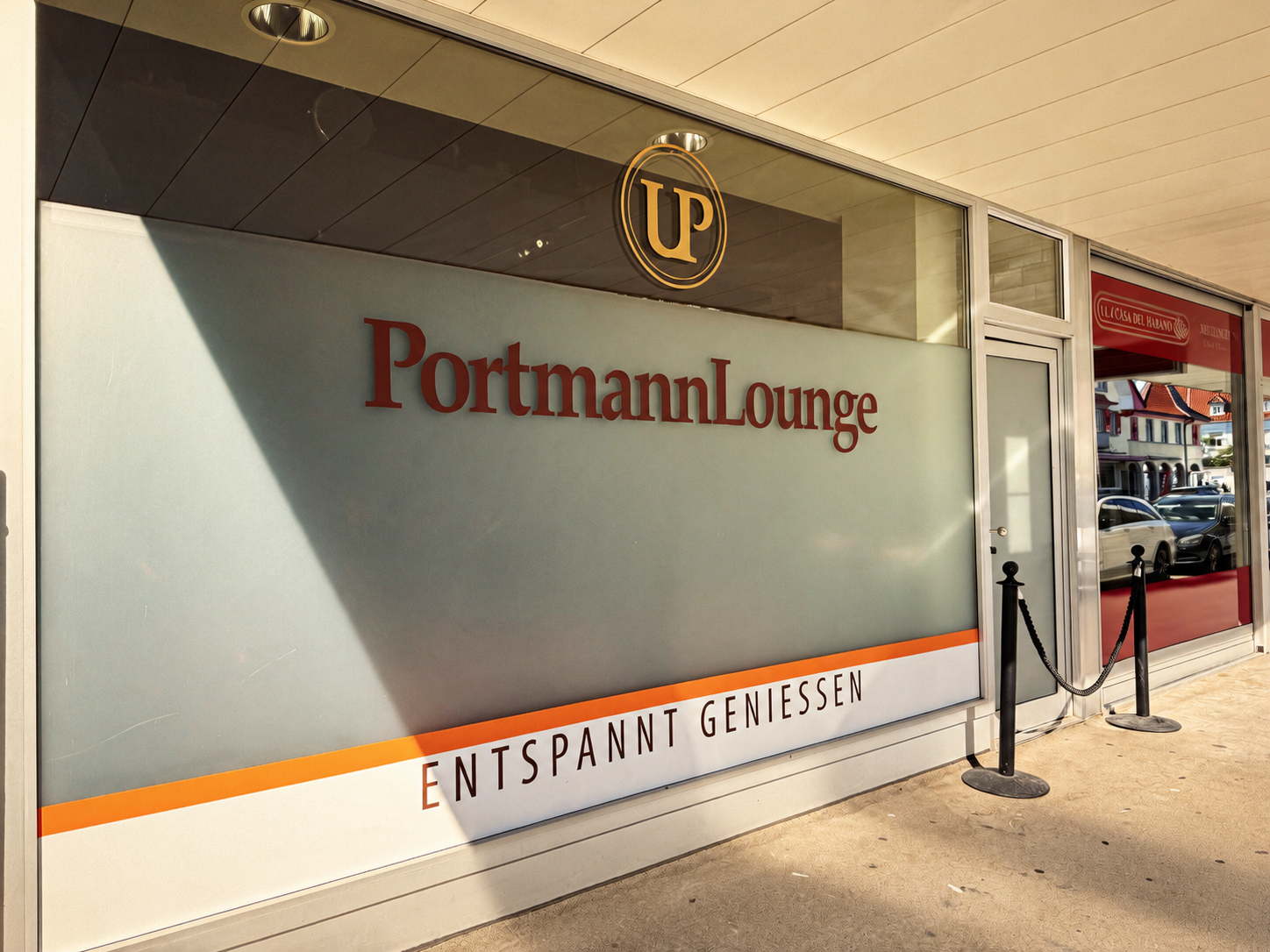
The Portmann Lounge in Kreuzlingen: three hours to enjoy Montecristo cigars, conversation and shared discoveries.
And then there were the canapés.
Lots of little bites.
A great many canapés.
I seem to have gone a bit overboard with the catering.

The most important thing when preparing for a four-hour cigar tasting? A solid foundation. That’s definitely not something it should come down to.
Today we’re not looking for leather, wood and earth
Before lighting the Montecristo Herederos, Vasilij suggested a slightly different approach to the tasting to the participants. That afternoon, the focus was deliberately not to be on the usual descriptions of aromas. Nobody had to look for notes of wood, leather, earth, coffee or other supposedly clearly identifiable aromas.

The evaluation begins before the first cigar is lit. The focus is on the smoke profile, balance, development, construction and burn.
The task was a different one: Let’s just see what the cigar does. What is its smoke profile like? How well-balanced is it? How does it develop as the cigar is smoked? How does the nicotine strength change? How well is the cigar constructed? How does it burn?
To this end, the participants were given a specially prepared tasting sheet. And this was put to good use: whilst smoking, they noted down their observations, recorded how the flavour developed, and later compared and discussed their findings with one another. This meant that the question «What does the cigar taste like?» not the main focus, but one that is far more exciting for this afternoon:
«Why does this cigar behave the way it does?»

Anything that stands out whilst smoking is noted down. Not in bullet points, but as specific observations.
The highlight of the day: the Montecristo Herederos

And here it is: the Montecristo Herederos. A cigar that’s not just something to talk about – it’s something you have to experience.
The highlight of the afternoon was, of course, the Montecristo Herederos. The cigar went down a treat with the participants. And, as is often the case with natural works of art made from tobacco, the mechanics of the burn wrote their own fascinating stories.
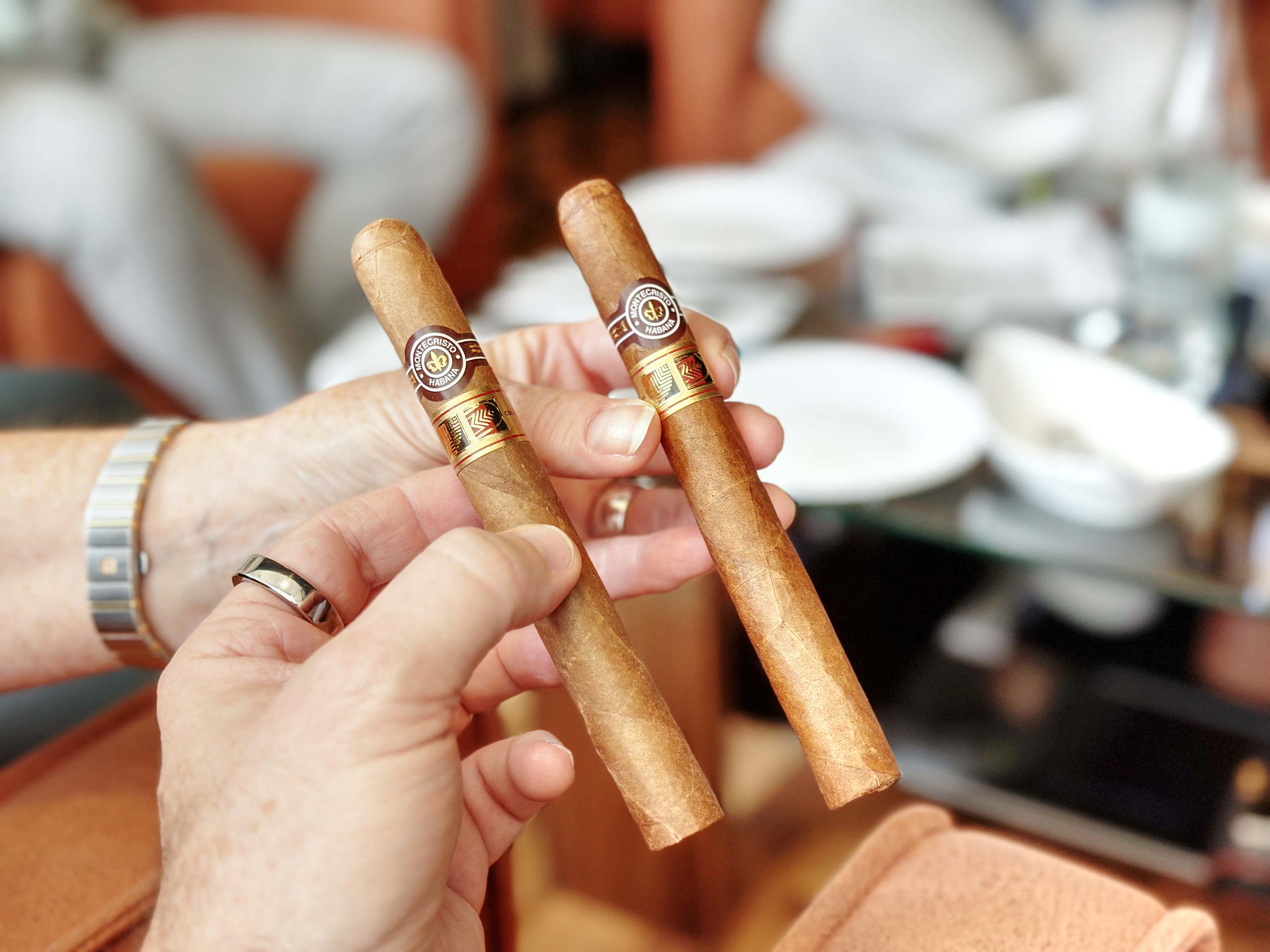
Two Montecristo Herederos, two cigars from the same box – and yet it’s still worth taking a closer look at each one.
Whilst one cigar struggled with an uneven burn, another put on a truly magical display: the connoisseur of this masterpiece decided to conduct a rather special experiment. He did not relight it, nor did he intervene to correct it; instead, he simply let his cigar burn freely to observe how it regulated itself. The result was an incredible burn – a phenomenon that even experienced aficionados had never seen before!

When a cigar burns in an unusual way, it gets interesting: what happened – and why? This was an isolated incident and I’ve never seen anything like it before.
It is precisely moments like these that are more valuable than any theoretical explanation. Because suddenly you can see first-hand what the construction, the heat, the draught and the tobacco do to each other – provided the smoker doesn’t intervene straight away. Absolutely fascinating!
Two hosts, two roles
The afternoon was led by Habanos historian and author Claudia Puszkar, along with Vasilij Ratej, editor of Zigarren.Zone. Claudia took charge of the historical section – and this went far beyond a few well-known dates. How did Montecristo come about? What is actually historically documented? Which stories have been passed down over the decades, even though they do not stand up to closer scrutiny? And how did it all actually begin with cigars in Cuba?

Claudia Puszkar and Vasilij Ratej co-hosted the afternoon – drawing on their knowledge and experience, and allowing plenty of scope for discussion.
Claudia captivated the audience with her in-depth expertise, thoroughly debunked persistent myths and took the guests on a fascinating journey through time to the origins of cigar culture in Cuba. Her highly engaging remarks were literally lapped up by the audience.
Meanwhile, Vasily had a different task: to occasionally disrupt the historical solemnity. With a few of his typically gentle touches of humour, he managed this with ease.

Cigar culture can be fun too. Perhaps it even has to be. Here, however, we take a close look: we observe the smoke pattern.
So just how old is this cigar, really?
Things got interesting during the sensory assessment of the cigar’s age: most participants estimated, based on the flavour, that the cigar was significantly older than the date printed on the box March 2026. That makes sense, as it was naturally rolled earlier. Originally, the Herederos was due to be released as early as 2020, but this was delayed by the global pandemic. Whilst the exact rolling date remains a closely guarded secret, connoisseurs estimated the actual age, based on the mature blend, to be around two years or older. The unanimous verdict of the group: This cigar has phenomenal ageing potential for a further two years Storage!
Of course, this isn’t a mathematical formula. But that is precisely what makes a group tasting like this so appealing: not awarding marks, but observing, comparing and discussing, why a cigar behaves the way it does.
A labour of love: „Origin Of Cigar“
Another part of the afternoon was devoted to Origin Of Cigar, the historical collection of Cuban cigar brands jointly established by Claudia Puszkar and Vasilij Ratej. During the event, participants were given two so-called «Archive Fragment» cards. Each card features a brief description of a Cuban cigar brand. Scanning the QR code takes you straight to a detailed history of the brand on Origin Of Cigar.

History you can experience first-hand: the archive clips from *Origin of Cigar* rounded off the afternoon with stories behind Cuba’s big names.
The project is driven above all by Claudia’s desire to bring together historical knowledge about Cuban cigar culture in one place. After all, there is a wealth of knowledge available. However, it is scattered across countless books, documents, archives and sources. And history has one unfortunate trait: sometimes it turns out to have been different from what was assumed for decades.
This is precisely where a digital collection has a decisive advantage over a printed book. A book is printed at some point. A website, on the other hand, can be updated, corrected and reassessed in the light of new sources.
Just how important this can be is illustrated, for example, by the story of H. Upmann. New historical findings paint a different picture from the one that has been passed down in the literature on cigars for many years. Origin Of Cigar is therefore not intended to be a monument to existing knowledge, but rather a living archive.
And a project close to Claudia’s heart.

A good cigar doesn’t require fancy words. It requires attention, time – and sometimes simply a moment of peace and quiet.
«We were just brilliant, weren't we?»
Eventually, this afternoon too drew to a close. Claudia and Vasilij stepped out in front of the guests once more. This would normally have been the moment when the hosts politely thank their guests and hope that everyone enjoyed themselves.
Actually.
Vasily opted for a slightly different approach.
«Claudia, normally the participants give the presenters feedback on how well they thought the event and the presentation went. Today we’re doing things a bit differently and turning the tables.»
A short break.
«We were just brilliant, weren't we?»
Heartfelt laughter filled the room.
For a moment, Claudia seemed genuinely surprised by this remarkably self-assured approach to quality assurance.
Then she laughed – and agreed. And with that, the official verdict was in.
And then there was Urs Portmann
Towards the end of the afternoon, Urs Portmann, the legendary founder of Urs Portmann Tabakwaren AG, also joined the guests. Today, his sons Marc and Thomas run the company together. In a sense, the new La Casa del Habano Kreuzlingen now stands between the main shop and the Portmann Lounge as a visible culmination of Urs Portmann’s decades of work.

From left: Marc Portmann, Urs Portmann and Thomas Portmann raise a toast together to mark this special milestone at the opening of the new Casa del Habano in Kreuzlingen on 29 June 2026. Two generations of passion, expertise and family history captured in a single photograph.
A fitting venue, then, for an afternoon in which the past and present of the Cuban cigar were constantly intertwined. Sunshine outside. Inside, cigar smoke, conversation, history, laughter – and 16 guests who had not merely smoked a Montecristo Herederos, but had observed and discussed it together.
A thoroughly enjoyable afternoon with lovely guests in a wonderful venue.
Thank you to the Portmann family for organising everything so perfectly. Thank you to Claudia for her vast knowledge of history. And, of course, thank you to all the participants, whose observations, questions and discussions made this afternoon what it was.
See you next time.
Find out more on this topic at Zigarren.Zone
Origin Of Cigar
Photos
- Vasilij Ratej
- Benno Baumgartner
Free eBook: PURO – A Journey to the Heart of the Cigar.
Forget superficial flavour lists. As a thank you to the zigarren.zone community (since 2014) I’ll give you my complete eBook as a PDF. Experience a fascinating glimpse behind the scenes: from the very first lighting, through the secret of ageing, to the true art of the blender. You’ll receive the download link just in time for Christmas 2026, sent directly by email.
 Deutsch
 English (UK)
 Français
 Italiano
 Español

A lovely event, an informative and entertaining article – or when you just can’t always be there …