
Cigar perception and sensory perception: How knowledge shapes your taste


You look at a cigar - and think you see what it is. But in reality, something else happens. Even before you take the first puff, your brain has long since decided what it will taste like. Expensive or cheap. Complex or linear. Special or ordinary.
And this is where the problem begins. Because you don't just taste tobacco.
You taste what you think you know about him.
In this article, you can experience this effect for yourself in an experiment - and see how much it changes your perception using two other specific case studies.
Brief summaryung for quick categorisation
Cigar perception is strongly influenced by prior knowledge: brand, price, origin and anilla (cigar ring) measurably change the flavour experience. Without this information - in a blind test - the same cigar is perceived as less complex and less valuable. In some cases, however, it can also have a surprisingly better flavour. Your own experience also plays a decisive role here.
This change happens before the first puff and cannot be corrected afterwards. The flavour of a cigar is therefore not only sensory, but also cognitive.
Cognitive in this context means: everything that happens in your head - your knowledge, your expectations, your experiences and what you think you know about the cigar.
Before you even take your first puff, your brain has already built up an image: expensive or cheap, rare or ordinary, special or average. It is precisely this inner image that influences how you perceive the flavour. So you don't just taste with your tongue - you always taste with your head too.
This can be clearly proven scientifically: expectation not only changes the evaluation, but also the actual perception of flavour in the brain.
What you can expect in this article
What is cigar perception?
Cigar perception describes the interplay of sensory impressions and cognitive processing.
In concrete terms, this means that what you taste is not only the result of tobacco, fermentation and processing - but also of what your brain makes of it.
A brief thought on this: Two people smoke the same cigar. One knows the brand, price and history. The other knows nothing. Both report different experiences. Not because the tobacco changes. But because the perception is built up differently.
The role of expectation: the invisible co-smoker
Expectation acts like a filter. When you hear that a tobacco is particularly old, you automatically look for depth and complexity. If you know that a cigar is expensive, you expect quality - and often find it. This doesn't happen consciously.
The brain works efficiently: it compares what you taste with what you expect and what you know or think you know. If it matches, the impression is reinforced. If it doesn't, irritation arises. This explains why the same cigar sometimes seems „complex“ and other times „linear“.
The anilla (cigar ring) as a visual signal
The Anilla is more than just decoration. It is a signal.
- It shows the brand
- It conveys style
- It conveys value
Even before you light the cigar, your brain has already categorised it. An elaborately designed anilla can create expectations that are directly transferred to your perception. Without this visual information, part of the orientation is missing. The assessment becomes more sober.
Knowledge does not change the tobacco - but the meaning
Knowledge does not change the physical properties of the cigar. It changes its meaning. One and the same flavour structure can be perceived completely differently:
- With context: „finely tuned“
- Without context: „too little expression“
- With expectation: „subtle and elegant“
- Without expectation: „unspectacular“
The sensory basis remains the same. What changes is the categorisation.
Why blind tasting is so different
Everything falls away in the blind test:
- No brand
- No price
- No story
- No visual categorisation
What remains is the pure sensory impression. And it is precisely here that a reduction is often evident: the cigar appears more direct, clearer - but perhaps less complex, or perhaps even the opposite. Not because it can do less or more, but because no expectation reinforces the perception. Blind tasting removes the context. And thus also part of the perceived depth.
This is precisely why the same cigar often seems simpler or even better without context - not because it is, but because part of the perception is missing.
Practical example: What you see before you know anything
Before you read on, please do something else for a moment. Just look at the following picture. The cigar without the anilla.
And then stop for a moment.
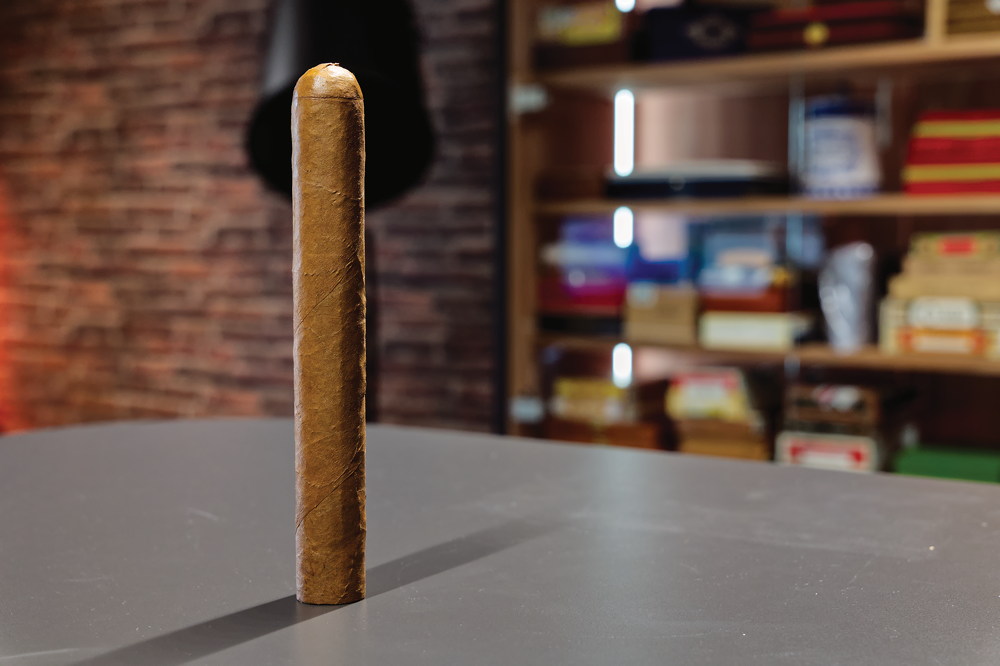
Write down a few keywords - just for yourself:
- What do you think of this cigar?
- How does it affect you?
- How would you rate their quality?
- Does it look special - or rather average?
- How much do you think this cigar costs? (The size is deliberately omitted - decide based on your impression only).
Really take a moment to do this. No scrolling. No thinking ahead. Just what you see. Because that's exactly the point. This picture shows a cigar without any information. No brand. No history. No visual categorisation.
Only tobacco, or rather only the image of a cigar in a certain visual environment.
What is missing at this moment is the haptics.
Scientific studies clearly show that haptics directly influence the perception of a product. Products are rated differently if they can be touched - often higher quality and more familiar. If this sensory impression is missing, as in this visual experiment, the categorisation changes automatically.
You can't hold the cigar in your hand. You can't feel how tightly it is rolled, how it yields, how the wrapper feels, how it smells. It is precisely this physical perception that would also influence your judgement - often more than you think.
But it is precisely this reduction that is crucial: you are forced to react only to what you see. And it is precisely this that reveals how strongly visual impressions and your prior knowledge already shape your perception.
Now read on - but don't look at the second picture yet. This is where the experiment begins. Because everything you have just thought is already perception. And this perception is not neutral. It is based on experience, on prior knowledge, on patterns in your head. You have categorised the cigar without knowing anything about it. And that's exactly what always happens.
I've left a lot of white space here so that you can't see the following photo straight away. Now you can look at the second picture.
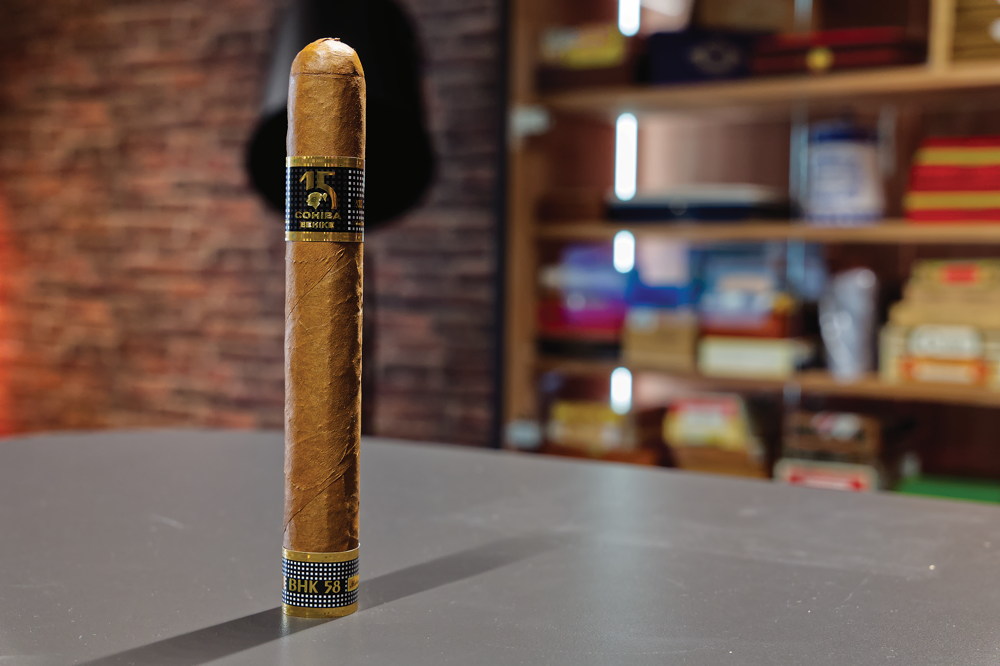
It shows the same cigar. With anilla. It is the new Cohiba Behike 58, presented at the Habanos Festival 2025 in Havana, Cuba - one of the most exclusive cigar lines in the world. Size:
Length 7 inch = 177.8 mm / ring 58.
And now the crucial question: has your perception changed? Does the cigar suddenly seem more valuable? More complex? More expensive? Or do you simply confirm what you thought before? Be honest and write it in the comments below (no registration required).
This example shows with radical clarity: it is not the cigar that has changed - but your view of it.
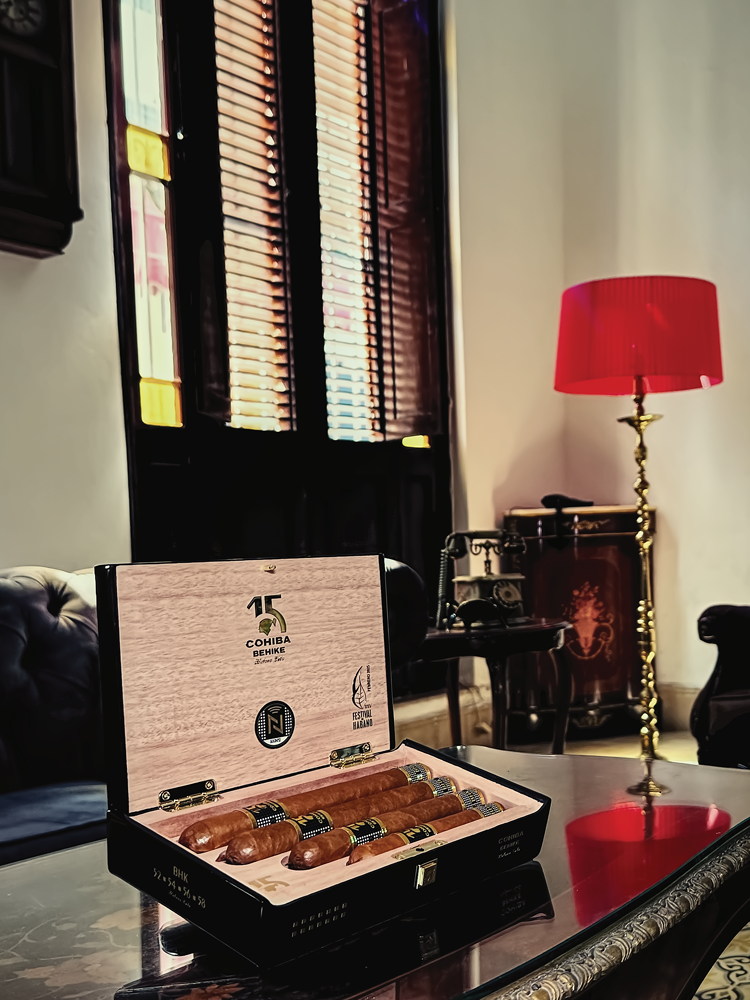
Photographed at the Habanos Festival 2025, Havana, Cuba. The set of 4 was launched on the Swiss market on 3 February 2026 for CHF 1,696. This corresponds to around CHF 424 per cigar - although the individual prices differ. No individual price is known for the Behike 58 at the time of publication of this article.
Practical example: Blind test vs. brand - when perceptions tilt
A concrete example shows how strong this effect is in practice: When VILLIGER introduced the CORRIDA brand, I conducted a blind tasting with five people. They all described the cigar as particularly aromatic and full-bodied. The price assessment was also significantly higher than the actual level.
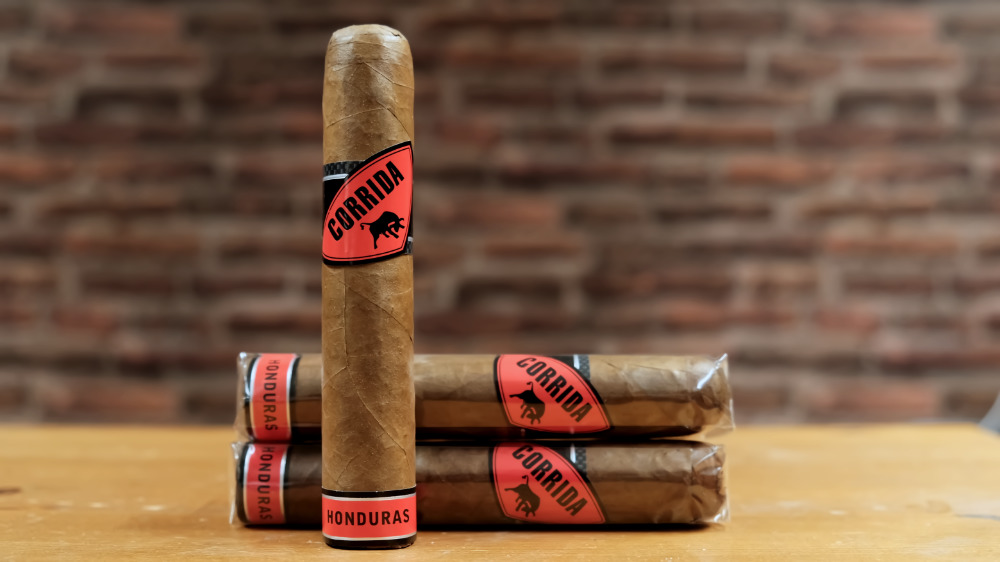
I tasted the new Corrida Honduras Robusto+ brand from Villiger blind in my lounge with 5 people. I already knew the cigar, but my 4 companions did not.
It wasn't until after the denouement that the surprise came: when I mentioned that the cigar was from Villiger, three participants immediately reacted with disapproval. „What? No, not Villiger, that's nothing!“
This shows how strongly prejudices influence perception - even if the actual taste experience was previously clearly positive. In the blind test, the cigar was perceived as high quality - with context, it was suddenly called into question.
Today, this picture has changed significantly: For many aficionados, premium long-fillers from Villiger have become an integral part of their portfolio.
Practical example: Expectation vs. reality - the same cigar, two completely different experiences
Another example shows how strongly expectation changes perception - even among experienced aficionados: In a structured comparison, I tasted the same cigar several times - once with full knowledge of the origin, concept and exceptionally long-matured tobacco, and once in a blind test without any information.
Specifically, it was about the Meerapfel MEIR Churchill cigar with a Cameroon wrapper aged for over 30 years and a filler made from decades-old tobacco. It is precisely this exceptional maturity that creates a high expectation of depth, complexity and balance.
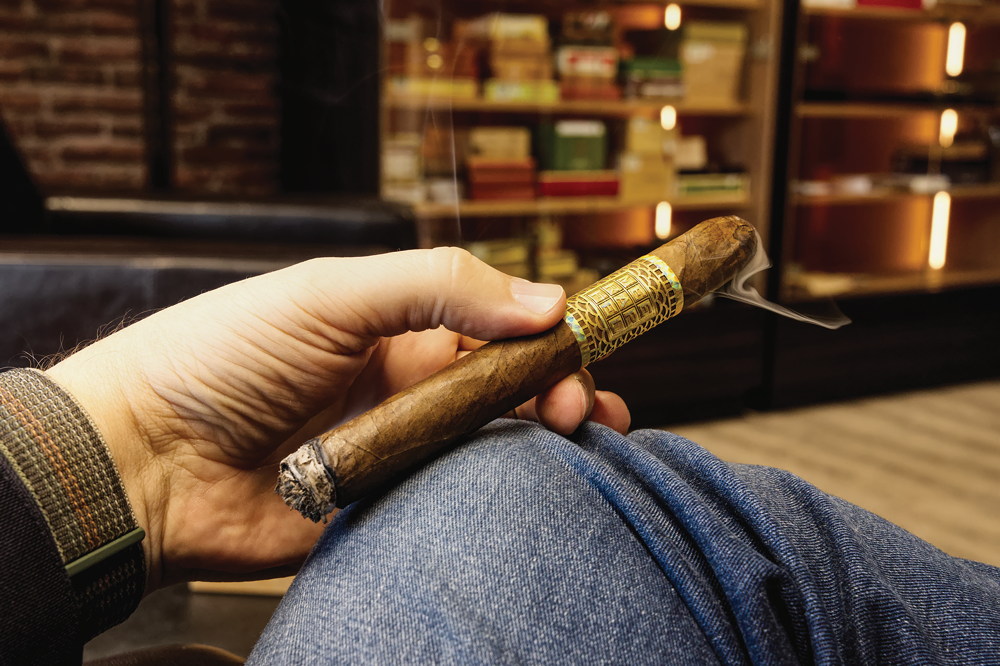
My solo tasting: The flavour of this decades-old tobacco is exceptional - the original sea apple Cameroon wrapper has matured for over 30 years. I was very enthusiastic. This perception changed in the blind tasting a few days later.
In this context, the cigar struck me as balanced, deep and multi-layered. The flavours intertwined, the composition seemed coherent and controlled. The expectation of tobacco matured for decades seemed to be confirmed.
In the blind test with two cigar friends, however, the picture changed significantly. The same cigar suddenly seemed calmer, more linear and less complex - even to me! Although the flavours were present, they stood side by side rather than forming a coherent overall picture. The rating was correspondingly more reserved.
This effect was also clearly evident in the price: without context, the cigar was categorised by experienced connoisseurs at around CHF 15 - while the actual price was CHF 63. This price is quite understandable in view of the exceptionally long-matured tobacco, but was not perceived in any way in the blind test.
The decisive factor is that the evaluation does not change even after the dissolution. Even after the origin, maturity and price are known, the impression of the blind test remains.
This example shows with rare clarity: expectation has an effect before the first move - and cannot be corrected afterwards.
What is clear up to this point
- Flavour is not only created in tobacco, but in interaction with expectations and prior knowledge
- Blind tasting shows how strongly context changes perception
- Price not only influences the rating, but also the actual taste experience
- Visual signals such as the anilla control the categorisation of a cigar
- Perception is not an objective process, but a constructed experience
The influence of price on flavour
Price is a particularly strong factor. A high price automatically signals quality, exclusivity and speciality. These signals have a direct effect on perception.
Studies clearly show that identical products are perceived as better if they are priced higher. A study by INSEAD Business School and the University of Bonn was even able to prove this effect in the brain. At the same time, activity increases in the areas responsible for reward and pleasure.
Researchers at Stanford University also show that the mere assumption of a higher price is enough to rate a product as having better flavour.
The effect is measurable: the brain reacts more strongly to supposedly more expensive products - even if they are objectively identical.
The crucial point: the price does not change the product. It changes what you taste in it.
The limits of objectivity
Many aficionados believe they can evaluate a cigar objectively. This is only partially possible. Because perception is always subjectively characterised by:
- Experience
- Knowledge
- Expectation
- Context
Even in the blind test, you bring your past with you. Objectivity is not a state. It is an approximation.
Significance for practice
What does that mean for you as a cigar smoker?
- Your impression is real - but not neutral.
- Blind tasting can help you to better understand your own perception.
- Context is not an enemy - but part of the pleasure. Because cigars are not just a product. They are also history, ritual and emotion.
And this is precisely where an exciting area of tension arises within the industry itself. Brand owners have respect for blind tastings. After all, what happens when experienced aficionados smoke a cigar without context - and they simply don't like it? What does this mean for the perception of the brand?
In recent years, I have been able to sensitise various brand owners to this topic. Step by step, the willingness to engage in this form of tasting has grown. Today, blind tastings are also possible in larger groups.
This is clearly demonstrated in two blind tastings that I conducted: an evening at the Bürgenstock Resort with a Gordo smoke, moments of pleasure and a mysterious puzzle - and another blind tasting at the Sonne Sissach with three box-pressed cigars, rum accompaniment and an evening full of suspense. In both cases, it became clear how strongly context and expectation characterise perception - and how differently cigars are experienced when this context is deliberately ignored.
And the result is the same every time: these evenings are exceptionally intense for the participants. Without expectation, without history, without visual categorisation, there is direct access to tobacco. Many are surprised at how different - and often more honest - a cigar feels when you simply smoke it and know nothing about it.
To the point
Cigar perception arises from the interplay of tobacco, knowledge and expectation. What you taste is significantly influenced by what you know about the cigar before you take your first puff.
Flavour is not an objective impression - but a constructed experience of sensory perception, expectation, prior knowledge and individual preferences that your brain creates even before the first puff.
FAQ: Cigar perception and sensory perception
-
Does the anilla (cigar ring) influence the flavour of a cigar?

Yes, it changes the expectation and thus the perception of flavour.
-
Why does a cigar taste different in a blind test?
Because visual and mental influences are eliminated and only the tobacco is assessed.
-
Can cigars be rated objectively?
Only to a limited extent. Perception is always subjective and context-dependent.
-
Why does an expensive cigar often work better?

Because the price creates an expectation that influences the taste experience.

Sources
Scientific sources
- SCP Society for consumer psychology (2024):
Current research shows that haptics are a central component of perception and directly influence evaluation and trust.
- SienceDirect. (2025)Study shows that haptic properties such as weight and firmness influence perception and purchasing confidence - but only when actually touched.
- Peck & Childers (2003)Study shows that haptics is a central factor for product perception and strongly influences how quality is assessed.
- INSEAD Business School / University of BonnStudy shows: A higher price changes the perceived quality of an identical product and measurably activates the reward system in the brain.
- Stanford University Graduate School of BusinessThe study shows that the assumption of a higher price alone leads to a product being rated as tastier.
- Plassmann et al. (2008) - NeuronNeuroscientific study shows that expectation changes the actual sensory perception in the brain - not just the interpretation.
- Frontiers in Psychology (2017)Explains the principle of „top-down processing“: perception arises from the interplay of sensory impressions and prior knowledge.
- ScienceDirectShows that visual and contextual factors such as design or presentation have a measurable influence on taste perception.
- PubMedThe review confirms that price, brand and context as „extrinsic factors“ directly influence the taste experience.
- Scientific AmericanPopular scientific classification: Expectation changes perception - also in taste.
Practical sources and own case studies
My own tasting experiences and documented blind tastings in the Cigar.Zone Lounge.
- Case study 1: Visual perception experiment using the Cohiba Behike 58 (Habanos Festival 2025, Havana, Cuba). Comparison of the same cigar with and without anilla for isolated observation of visual perception and its influence on quality assessment and price perception.
- Case study 2: Blind tasting for the launch of Villiger's Corrida brand with five participants. The cigar was rated as aromatic, full-bodied and higher priced without any brand knowledge. The extent to which existing prejudices about the Villiger brand influenced perceptions only became apparent after the tasting had ended.
- Case study 3: Structured comparison of the Meerapfel MEIR Churchill in solo tasting with a known context and blind tasting with two cigar friends. The focus was on the perception of a cigar with a Cameroon wrapper aged for over 30 years and a decades-old filler. With context, it appeared deep and multi-layered, whereas in the blind test it was much calmer, more linear and priced much lower.
Picture credits
- Vasilij Ratej
- Photo cover: Christian Schmid, FotoWerk 132

More smoke. With me.💨🤗
YOUTUBE 📺 @genussmitvasilij
INSTAGRAM 📸 @v4silij
INSTAGRAM 📸 @zigarrenzone
 Deutsch
  English (UK)
  Français
  Italiano
  Español
How true, how true - even at the risk that Hananos and Davidoff don't like it at all 😜.
I estimated your first photo to be of very good quality, but in Mareva format. Something like Vega Fina or Siglo II. Nice try! I can confirm everything. A very good friend once brought me a Behike 52 without a band. Unbeknownst to me, it was my first. Impeccable craftsmanship and very rich in flavour. Nevertheless, disappointment in relation to the market price after dissolution.
Sometimes I also look for flavours in well-known cigars with Anila that I knew but can no longer taste. For example, recently a Cohiba Robusto, where I couldn't taste the always wonderful nutty flavour, or the Corrida-Brasil, whose sweetish sweetness only flashed up very briefly in the second third.
Ultimately, cigars are natural products that also differ within brands and formats. In addition, there is always the individual form of the day.
Cheers to the blind tastings!
Hello Georg,
wonderful examples that you have shared with us - thank you very much!
I am now starting a new series of experiments: my wife will select five cigars from the humidors, remove the anillas and deliberately NOT put any numbers or markings on them (who knows - maybe even that will have an effect 😅). Instead, she simply puts the cigars in a humi bag and makes a separate note of the order (the humi bag remains sealed in the humidor for safety).
I then smoke them from left to right, and after each cigar I get the resolution.
I'm already looking forward to it!
Exciting, maybe you'll report back!
I would find it hard to imagine removing the anilla from my Habanos before they are lit. Just a matter of the head😝
I will definitely report back!
Consumers can be deceived in many ways: price, packaging, „brand“, etc. Whether cigars, wine, muesli..., the „evaluation“ is always subjective and biased.
Yes, that's completely normal. I find it extremely interesting how this works in a blind tasting.