
60 Years of Cohiba: How the logo and banderole help prevent counterfeiting


To mark Cohiba’s 60th anniversary, Habanos S.A. traces the evolution of the brand’s visual identity. The most significant point in the announcement of 13 August 2026 is the expansion of the banderole’s role from a distinguishing feature to an integral part of the authenticity verification process: in the revamped Línea Behike range, NFC technology is also being used on the packaging and the main banderole for this purpose.
In this article
Key points at a glance
- Manufacturer: Habanos, S.A.
- Brand: Cohiba
- Reason: 60th anniversary of the brand
- Subject: Design of the logo, chequerboard pattern and banderoles, as well as their security features
- Latest update: NFC technology on the packaging and the main sleeve of the revamped Línea Behike range
- Further security features: Holograms, microprinting, embossing and elements visible under UV light
- Origin: Cuba
- Price, availability and limited edition: Not mentioned in the press release

To mark its 60th anniversary, Habanos is putting the spotlight on Cohiba’s recurring design elements.
Invitation from Zigarren.Zone
Have you heard of the new ‘sensreset.’ section yet? Have a listen!
What's new?
It is not the Cohiba logo that is new, nor is it the basic principle of secure packaging. Habanos has been using holograms, microprinting, embossing, barcodes and other forms of identification for years. The latest development involves combining the revamped Línea Behike with NFC on two levels: on the packaging and on the main banderole. The banderole thus no longer serves merely as a means of visual recognition and as a carrier of printed security features, but also acts as a digital interface.
The press release does not provide any technical details regarding the stored data set, the verification procedure or the duration for which the linked information will be made available. Nor does it specify prices, the market launch by target market or the extent of availability.
Why is this interesting?
Authentication is important for well-known and high-value cigars. Visible features can be copied. However, multiple independent levels of verification make the task more difficult for counterfeiters. The combination of printing, holography, UV features, packaging labelling and NFC creates additional checkpoints. NFC can also provide access to information without taking up extra space on the banderole.
However, the key factor remains how the system is technically implemented. The press release does not specify whether each chip has a unique identifier, how attempts to copy them are detected, or whether buyers can view the full supply chain. It is therefore not possible to make a reliable assessment of the level of protection based on the manufacturer’s information alone.
For collectors, the integration into the sleeve changes its function. It is no longer merely a design element, an indication of origin or a collector’s item, but part of a digital infrastructure. Whether this will result in more reliable authenticity checks in everyday use remains to be seen, depending on how it is actually applied.

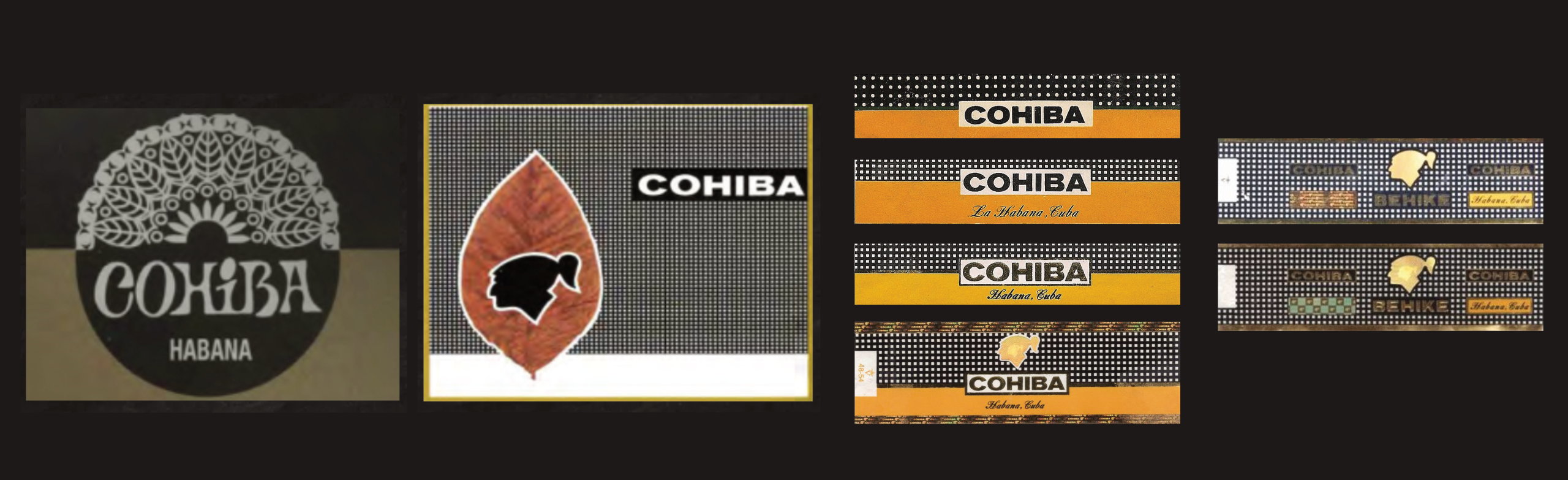
The Taíno head, the black-and-white grid and yellow gold have formed the visual core of the brand for decades.
From brand image to authenticity checks
Since 1966, Cohiba has been closely associated with a few recurring design elements: the black silhouette of a Taíno head, the black-and-white chequerboard pattern, the yellow-gold colour scheme and the brand’s lettering. According to Habanos, the name Cohiba derives from a Taíno term historically associated with tobacco.
👉 TIP: Please read the full history of COHIBA at Origin Of Cigar
This visual continuity serves, first and foremost, a simple purpose: it makes the brand recognisable. In the case of cigars, however, the band has taken on a second function. It bears features designed to make counterfeiting more difficult and to provide buyers with clues for checking a product. The design did not come about in a single step. Habanos cites an early design by Daniel García Rojas featuring interwoven tobacco leaves. Mario Solá Méndez later introduced the simplified black outline and a more strictly structured graphic layout.
A design attributed to Benjamín Echavarrea from the late 1980s retained the Taíno profile, lettering and chequerboard pattern. These were complemented by a golden-yellow colour scheme and references to Havana and Cuba.
The sleeve has been redesigned several times
The first Cohiba band, introduced in 1969, remained in use until the early 1970s. This was followed by a version that was used until around 1993. The third version featured the words ‘La Habana, Cuba’ for the first time and remained in use until 2003. Between 2003 and around 2014, embossed elements were added. With the Behike band introduced in 2010, Habanos used two security holograms for the first time. This was followed in 2013 by newly designed holograms and microprinting.
Since 2012, Habanos has been using a new generation of bands, initially on the Pirámides Extra and later on other vitolas. Their features include embossed detailing, a holographic logo, holographic stripes and elements that fluoresce under ultraviolet light.
NFC links products with digital information
NFC stands for Near Field Communication. The technology enables contactless data exchange over a very short distance. A compatible smartphone can read an NFC chip without a camera having to scan a printed code. At Habanos, NFC was first used on the boxes of Cohiba Siglo de Oro. This vitola was launched to mark the 30th anniversary of the Línea 1492 and the Chinese Year of the Rabbit. By scanning the box, buyers can verify the cigar’s authenticity and access additional product information.

Close-up of the cigar band. Note the holographic elements in various places. The print and embossing are crisp and clear. Photo: Vasilij Ratej, zigarren.zone
With the launch of the Cohiba Behike 58, Habanos has also revamped the look of the entire Línea Behike range. According to the press release, NFC technology is incorporated into both the packaging and the main band. This means that, for the first time, the brand element attached directly to the cigar – which is often collected – is also included in the digital verification process.
Source: Based on the press release from Habanos S.A.
Further reading:
→ Please read the full history of COHIBA at Origin Of Cigar
Find out more on this topic at Zigarren.Zone
Photos
- Habanos S.A.
- Vasilij Ratej, cigars.zone
Free eBook: PURO – A Journey to the Heart of the Cigar.
Forget superficial flavour lists. As a thank you to the zigarren.zone community (since 2014) I’ll give you my complete eBook as a PDF. Experience a fascinating glimpse behind the scenes: from the very first lighting, through the secret of ageing, to the true art of the blender. You’ll receive the download link just in time for Christmas 2026, sent directly by email.
 Deutsch
  English (UK)
  Français
  Italiano
  Español