
Why Cigars Are Part of Our Cultural Heritage – An Explanation of Craftsmanship, History and Tradition


Cigars: Cultural Heritage / Some things endure for generations. An old clock does more than simply tell the time. A hand-bound book is more than just paper. A historic violin is far more than wood and strings. Such things tell stories. They embody the knowledge and experience of many generations. It is much the same with cigars. Those who view them merely as a tobacco product see only the finished product. Those who look more closely recognise a cultural heritage that has evolved over centuries.
This article is part of the „Understanding Cigars“ series – a series covering the basics of cigars by Zigarren.Zone. You can find the whole series here
In this article
A brief explanation
Cigars are regarded as a cultural asset because they are far more than just a consumer product. They embody agricultural knowledge, craftsmanship, regional traditions and cultural history. From tobacco cultivation through fermentation to hand-rolling, knowledge that has been built up over generations is passed on. A cigar is therefore an expression of human experience and artisanal culture – not merely a product to be smoked.
What ‘cultural heritage’ means
Not everything that is old automatically becomes cultural heritage. Cultural heritage arises where people develop, preserve and pass on knowledge over a long period of time. This includes buildings, musical instruments, traditional crafts and historical manufacturing processes.
They all have one thing in common: they bridge the past and the present. That is exactly what happens with cigars, too.
A tradition stretching back centuries
Tobacco cultivation dates back several centuries. Over generations, farmers have learnt which soils are suitable, when the leaves need to be harvested, and how they should be dried and fermented. This knowledge did not originate in a laboratory; it was developed through experience.
Many of these insights are still passed down from generation to generation today. Each harvest builds on the knowledge of the previous one.
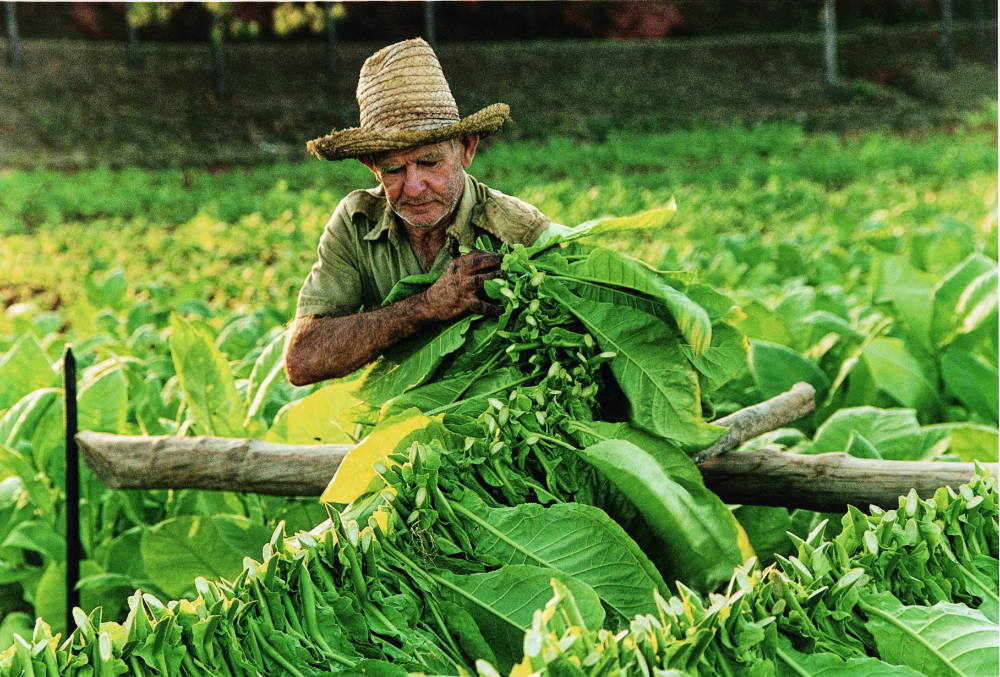
Before a leaf is fermented or rolled into a cigar, it is cultivated under the watchful eye of the tobacco farmer. His experience shapes the character of the tobacco right from the start.
Craftsmanship rather than mass production
A cigar is not made entirely by machines. Many stages of the process require experience and a delicate touch. The leaves are sorted. Their quality is assessed. They are fermented, aged and later blended by hand. Rolling a cigar, too, remains a craft. Every movement determines how the draw, burn and smoke production will perform later on. This knowledge cannot be fully automated; it has to be learnt.
People remain the most important element
The first foundation is laid right there in the tobacco field. The tobacco farmer decides which varieties to grow, when to harvest the leaves and how to assess their quality as they grow. His experience shapes the character of the tobacco long before it is turned into a cigar.
No machine decides which tobacco leaves will go well together later on. That task falls to the Master Blender. He knows the characteristics of the various tobaccos, their origin, how they develop and the role they play within a blend. His work is similar to that of a conductor. The instruments are there. But it is only when they are brought together that they form a composition.
The torcedores – the cigar rollers – also play their part. Their expertise determines whether individual leaves can be turned into a cigar that meets the manufacturer’s standards.
Every region tells its own story
Cigars are not made in the same way everywhere. Cuba has developed its own traditions. The Dominican Republic has gone its own way. Nicaragua, Honduras, Ecuador and Mexico also have their own distinctive characteristics. It is not just the soil and climate that differ; working methods, training, fermentation and processing have also developed differently from region to region. This gives rise to different artisanal cultures.
Knowledge that isn’t found in books
Much of the knowledge about cigars has never been recorded scientifically. It has been acquired through observation. An experienced tobacco grower can often tell at a glance when a leaf is ready to be harvested. A fermentation master senses changes long before they become measurable. A torcedor can tell whilst rolling whether a cigar will smoke cleanly later on. Such knowledge is the result of decades of experience. It can only be learnt to a limited extent from textbooks.
Cigars bring many professions together
Before a cigar is ready, numerous people are involved in its production. These include, amongst others:
- Tobacco farmers
- Field worker
- Sorter
- Fermentation Master
- Quality Control Officers
- Master Blender
- Torcedores
- Packaging specialists
- Industrial designers & graphic designers
- Printing companies specialising in cigar bands
- Factories producing packaging (boxes, cellophane)
- Logistics companies
- Specialist retailer
- Bloggers & journalists
Each of these professions plays a small part in the finished product. A cigar is therefore always the result of a collaborative effort.
Culture is changing
Cultural heritage does not mean standing still. Cigars, too, continue to evolve. New growing regions are emerging. Manufacturers are experimenting with fermentation processes. Blends are being refined. New formats are being introduced. At the same time, many traditional production methods are being preserved. It is precisely this combination of tradition and innovation that keeps a culture alive.
More than just a treat
A cigar is often associated with special moments. People smoke them at celebrations, anniversaries or after making important decisions. Others enjoy them as a deliberate break from everyday life. The cigar itself does not create these moments. But it accompanies them. As a result, for many people it becomes part of their personal memories. That, too, is part of the culture.
Why culture does not need to be assessed
Not everyone has to like cigars. Just as not everyone has to listen to classical music or admire old paintings. Cultural heritage does not demand approval. It deserves understanding. Anyone who recognises how much knowledge, experience and craftsmanship goes into a cigar will see it in a different light – regardless of whether they smoke themselves.
Responsibility for the future
Cultural heritage can only be preserved if knowledge is passed on. Young tobacco farmers must learn the trade. New torcedores must be trained. The knowledge of the master blenders must not be lost. Equally important is media coverage that explains how cigars are made and why their production is so demanding. For only what is understood can be preserved.
What you might see when you smoke your next cigar
The next time you light up, it’s worth pausing for a moment. Not to search for individual flavour notes, but to realise just how many people and how many years of experience have gone into this single cigar. Every leaf has been grown. Harvested. Dried. Fermented. Aged. Sorted. Blended. Rolled by hand. Inspected. Packaged.
Only then will it be in your hands.
Conclusion
A cigar is far more than just a natural tobacco product. It brings together nature, craftsmanship, experience and history into a single whole. It embodies knowledge that has been built up over generations and is still preserved today by people who have mastered their craft. That is precisely why a cigar deserves our attention – not merely as a luxury item, but as an expression of a living craft tradition. It does not tell a story simply because it is smoked.
It tells a story because people have been creating it for centuries with knowledge, patience and skill.
Frequently Asked Questions
Why are cigars regarded as a cultural asset?
Cigars are regarded as a cultural asset because their production brings together centuries-old knowledge of tobacco cultivation, fermentation and craftsmanship. Tobacco farmers, master blenders and torcedores often pass on their expertise from one generation to the next, thereby preserving traditional craftsmanship. A cigar is therefore far more than just a tobacco product – it is the result of human knowledge, craftsmanship and a living culture.
Why can’t the production of high-quality cigars be fully automated?
Many stages of the process rely on experience and observation. Selecting the leaves, fermenting them, creating the blend and rolling them by hand all require skills that machines have not yet been able to fully replace.
Why is knowledge so important to cigar culture?
The quality of a cigar does not depend on the tobacco alone. It is the result of experience passed down through the generations. Without this knowledge, traditional production methods and craftsmanship would be lost.
The comprehensive guide to cigars
Every cigar tells its own story. If you really want to understand them, you should also know how tobacco is grown and processed, and why a cigar behaves the way it does. This educational series takes you step by step through the most important basics – explained in an accessible way and backed by scientific evidence.
How aroma descriptions are created – and where their limitations lie
Many cigars are described in terms of their flavour. But does that really capture the essence of the cigar? Find out why the tobacco itself is the most important benchmark.
→ How aroma descriptions are created – and where their limitations lie
What really makes a cigar strong? Explaining a cigar’s strength
Strength and flavour are two completely different characteristics. Find out why the same cigar can be perceived differently by different people.
→ What really makes a cigar strong? Explaining a cigar’s strength
What fermentation actually does
Fermentation is one of the most important stages in tobacco processing. Find out what happens to the tobacco during this process and why it is so crucial for the final cigar.
→ What fermentation actually does
Cigar Wrapper – Why wrappers are underrated
The wrapper is much more than just an attractive covering. Find out how it influences the character of a cigar and why its colour is often misinterpreted.
→ Cigar Wrapper – Why wrappers are underrated
Cigar Blend – What really makes a great blend
A great blend doesn’t happen by chance. Learn how different tobaccos come together to form a harmonious whole, and why balance is more important than dramatic changes.
→ Cigar blends: What really makes a great blend
How tobacco changes physically when smoked
As you smoke, the tobacco changes with every puff. Discover how heat, moisture and the moving ember affect the smoking experience.
→ How tobacco changes physically when smoked
Why consistency is a greater achievement than constant change
Many people believe that a cigar must constantly change. Find out why consistency, in particular, can be a sign of great craftsmanship.
→ Why consistency is a greater achievement than constant change
Terroir Cigars – Soil, climate and tobacco cultivation explained simply
Climate, soil and origin shape the tobacco long before it is harvested. Discover how the terroir influences the character of a cigar.
→ Terroir Cigars – Soil, climate and tobacco cultivation explained simply
Observe cigars rather than judge them – How to understand cigars better
You don’t need to rate a cigar to understand it better. Learn what to look out for and how your perspective on cigars will change.
→ Observe cigars rather than judge them – How to understand cigars better
Why Cigars Are Part of Our Cultural Heritage – An Explanation of Craftsmanship, History and Tradition
Cigars are much more than just a luxury item. Find out why they have been part of craftsmanship, history and culture for centuries.
Scientific sources
- UNESCO – Convention for the Safeguarding of the Intangible Cultural Heritage. UNESCO describes intangible cultural heritage as knowledge, skills and traditional crafts that are passed down through the generations.
- UNESCO – Handbook on Intangible Cultural Heritage (2022). Explains the importance of traditional crafts and their transmission as part of our cultural heritage. You can search here.
- FAO – The State of the World’s Biodiversity for Food and Agriculture. Describes the importance of traditional agricultural knowledge for the preservation of cultural and agricultural diversity.
If cigars are a cultural asset – what actually gives them their distinctive character?
The answer begins long before a cigar is rolled. It takes shape in the soil, during fermentation and when the blend is put together. Read next:
- What fermentation actually does
- What ‘terroir’ means in the context of cigars
- What really makes a great blend
Photos
- 5TH Avenue Products Trading GmbH / Habanos S.A.
 Deutsch
  English (UK)
  Français
  Italiano
  Español
Responses