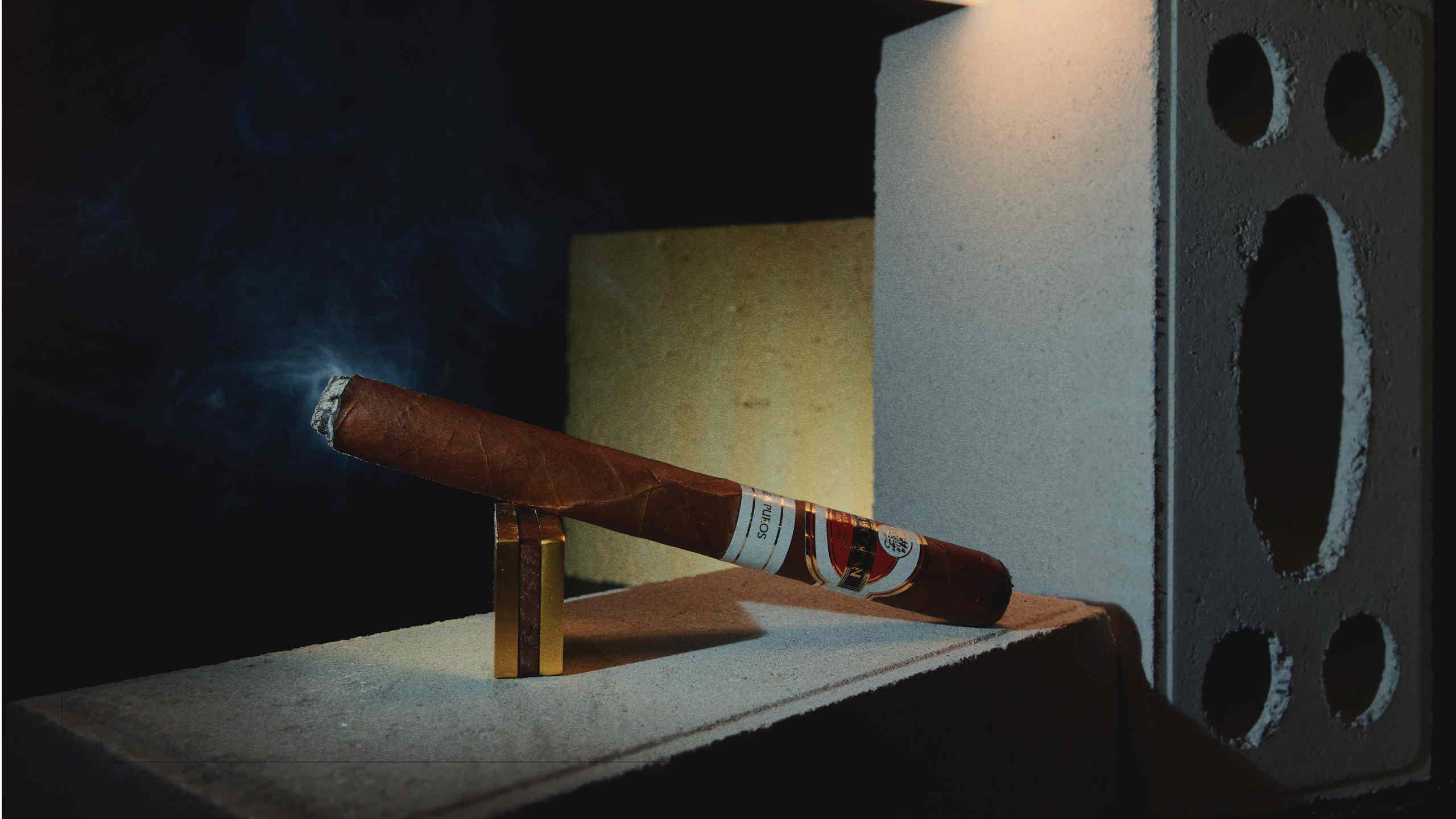
I’m tasting the Camacho Ecuador Robusto from the Alutubo: a rather light smoke fills the room and quickly dissipates, whilst a complex interplay of umami, gentle acidity and peppery retronasal aromas awakens on my tongue. The Camacho Ecuador Robusto from the Alutubo reveals its lively character right from the very first puff.
In this review

Smoke pattern – How does the smoke behave?
Right from the very first puffs, I notice the distinctive quality of the smoke. A rather light smoke forms in the mouth. It doesn’t linger as a heavy or oily sensation, but dissipates surprisingly quickly and smoothly once you’ve exhaled.
Why does the cigar behave like this?
How thick and heavy the smoke feels in the mouth, or how quickly it dissipates in the air, depends on various factors. Among other things, the moisture content of the tobacco, the tightness of the roll, the composition of the leaves used and the individual’s smoking rhythm all influence the density of the smoke.

Balance and Development – How the flavour profile evolves
The tasting begins on my tongue with a striking combination of umami and bitterness – which is by no means unpleasant – accompanied by a slight acidity.
In the first half, this impression changes gradually: The umami notes remain, the acidity is subtle and the bitterness is noticeably less pronounced. When I draw the smoke retronasally through my nose, a peppery note emerges, accompanied by a rich aroma that then settles on the tongue.
In the second half, the flavour profile comes more to the fore: I detect more umami and a more pronounced acidity, whilst the bitterness recedes a little further.
Why does the cigar behave like this?
The development of flavour and the interplay of basic taste sensations such as umami, bitterness and acidity are determined by the blend of tobacco leaves, their fermentation and the blending ratio. The cigar’s body becoming shorter, the rising temperature of the embers and the build-up of condensation in the last third also alter the perception of flavour as the cigar is smoked.
What is umami?
In ‘Tasting Notes’, the term Umami used to describe a subtle, savoury and mouth-watering depth in the smoke. Unlike distinct flavours such as spiciness or sweetness, umami creates a balanced, rich and long-lasting flavour sensation on the tongue and in the finish.
Invitation from Zigarren.Zone
Have you heard of the new ‘sensreset.’ section yet? Have a listen!
Strength – How does strength develop?
The nicotine strength builds up quickly and soon reaches a moderate level of 3/5. This sensation of strength remains constant and lasts steadily right through to the second half.
Why does the cigar behave like this?
The perceived strength of a cigar is determined by the nicotine content of the tobacco varieties used (such as the leaf grades Ligero, Seco or Volado) and the degree of curing. How strong the nicotine is perceived to be also depends on the speed at which the cigar is smoked and how one is feeling on the day.

Why the Batman symbol appears here is a mystery to me too 😅 And no, it isn’t AI-generated – it’s lit up like that using a special LED.
Construction and burn – How clean is the cigar?
The draw resistance is excellent – perhaps just a tiny bit too strong for my liking, but the airflow is absolutely top-notch.
The burn is completely even and straight right up until the start of the second half. After that, there is occasionally a slight uneven burn. Once, after clearing the ash, and again later on, I briefly adjust the burn zone with the flame, whereupon the cigar continues to burn cleanly.
Why does the cigar behave like this?
The draw resistance depends on how tightly the inner leaves are rolled and the firmness of the roll. An uneven burn may be caused by an uneven distribution of tobacco, variations in moisture content within the wrapper, or draughts.
Conclusion
The Camacho Ecuador Robuste in its aluminium tube produces a rather light smoke throughout the smoking experience, which dissipates quickly. In terms of flavour, it develops from an initial combination of umami and bitterness towards more umami and fresh acidity, whilst peppery notes add accents on the retronasal palate. The draw resistance is excellent. The cigar burns perfectly straight until the halfway point, before a brief adjustment with the flame is required in the second half. An honest, characterful smoking experience with medium strength.
Frequently Asked Questions
How strong is the Camacho Ecuador Robusto in this tasting?
The strength starts at 3/5 shortly after lighting and remains constant at this medium level well into the second half. Towards the end, it reaches 4/5.
How does the flavour profile develop as the smoke progresses?
Initially, umami, bitterness and a slight acidity dominate. The bitterness subsides in the first half. In the second half, the umami and acidity intensify further, whilst the bitterness diminishes slightly. On the retronasal palate, the smokiness has a peppery quality.
How does the cigar burn?
Up until the start of the second half, the cigar burns evenly and straight. After that, it occasionally burns at an angle, which had to be corrected once with the flame after ash removal.
Further reading
Sources and background information
This article is based on my tasting of the cigar described, drawing on my own experience as a cigar connoisseur since 1996, as well as on specialist literature on tobacco, fermentation, ageing and the physical processes that occur during smoking. In addition, recent scientific publications on tobacco fermentation and on heat and mass transfer in tobacco have been taken into account.
- Hu, W. et al. (2022): Study on the chemical compositions and microbial communities of cigar tobacco leaves fermented with an exogenous additive. Scientific Reports. → Fermentation, chemical changes and microbial processes in cigar tobacco.
- (2023) Study on the correlation between the dominant microflora and the main flavour compounds in the fermentation process of cigar tobacco leaves → Investigates the relationships between dominant microorganisms and key chemical indicators.
Photos
- Vasilij Ratej, without AI