
How a harmless online purchase became a legal problem and a fire hazard

Dear cigar lovers,
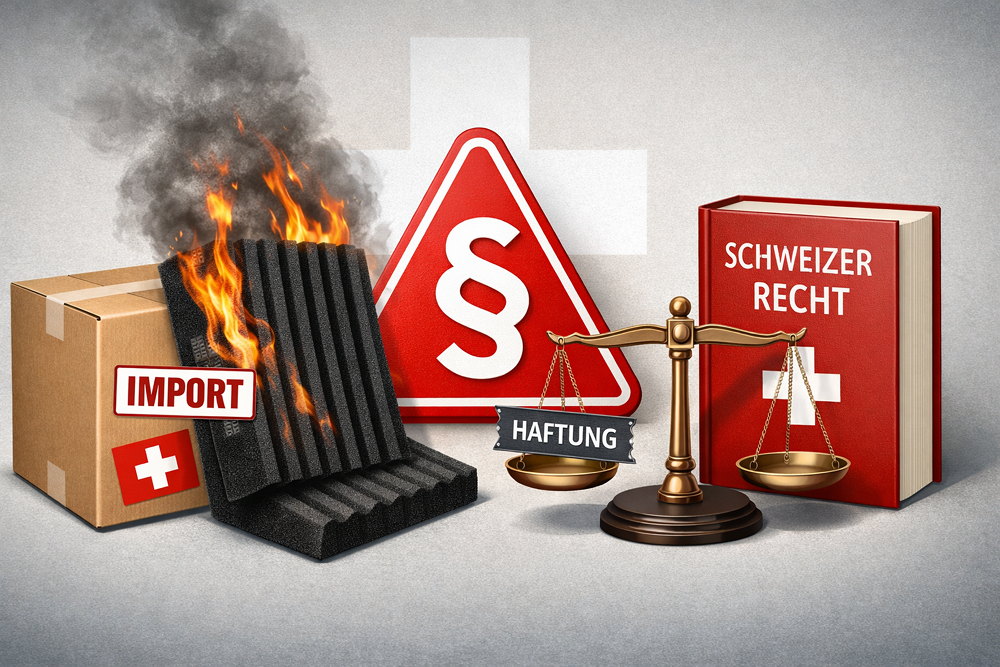
For once, this article has nothing to do with cigars. It is aimed at consumers in the Switzerland, which online shopping - often in good faith and without realising the legal consequences. What looks like a normal online purchase can turn out to be a legal minefield. This report is intended to sensitise, not accuse. Anyone who shops online in Switzerland and purchases goods from abroad will legal to the importer - with all the consequences.
A personal experience report on a little-known legal pitfall in Switzerland
When does a consumer suddenly become an importer? And why is the seller not liable if a product is not authorised in Switzerland? This is exactly what happened to me - after a completely normal purchase in a well-known, reputable online shop. And suddenly it could even have become extremely dangerous and I would have had to bear the legal consequences.
The purchase - and the wrong assumption
In 2023, I bought acoustic panels in a renowned online music shop. The price was quoted in Swiss francs and I also paid in CHF. For me it was clear: a purchase as a Swiss consumer for use in Switzerland.
What I didn't realise was that the goods were delivered from Germany and the online shop is domiciled in Germany, so it doesn't have a Swiss branch. Legally, it was therefore not a domestic purchase, but an import - with far-reaching consequences.
The trigger: the fire disaster in Crans-Montana
After the tragic fire disaster in a bar in Crans-Montana at the beginning of 2026, a simple but crucial question arose for me: Do the acoustic panels installed in my office the Swiss fire protection regulations? I contacted the Basellandschaftliche Gebäudeversicherung (BLGV) and asked them to check.
The response from the building insurance company
The BLGV recommended that I request a Swiss fire protection certificate from the seller. The seller forwarded my enquiry to the manufacturer. He listed the fire tests carried out in Germany. I forwarded all the documents in full to BLGV.
The sobering realisation
The answer was clear: the acoustic panels have No fire protection certificate valid in Switzerland. The clear recommendation was to remove the panels and dispose of them. I followed this recommendation.
Your own fire test
Before disposing of it, I carried out a simple outdoor fire test out of my own interest. A small piece burned immediately, produced strong, acrid smoke and even a small amount caused a strong coughing sensation. The test took place outside at minus 10 degrees - but the result was still worrying. The question arose: What would have happened in a closed room in an emergency?
👉 The fire test can be seen uncut on YouTube, please click here.
To clarify:
After removing the panels, I gave them away to a company that repairs audio systems for events. They confirmed to me in writing that the panels could only be used as Packaging material used and Not installed become.
The crucial question: What rights do I have as a buyer?
After it became clear that the products were not authorised in Switzerland, I contacted my legal expenses insurance company. The answer was sobering: in this situation, I am responsible as the buyer. There are no automatic claims against the seller.
The real pitfall
I assumed I was buying in Switzerland - partly because of the price in CHF. I did not realise that it was an import. Even more serious: I was not aware that I was legally recognised as an importer. Importer apply.
And this is precisely the crucial point.
A systemic problem for consumers
In such cases, consumers are not given the opportunity to unknowingly to importers. In doing so, they assume responsibility for:
- compliance with Swiss law
- Standards and certificates
- Possible legal violations
- Safety-related risks
These consequences are neither transparently communicated nor recognisable to laypersons.
My lawyer explains and recommends
My lawyer Timotheus Winzenried writes:
If the panels were imported from abroad and the buyer is the contractual partner of the foreign seller, he is deemed to be the importer under Swiss law. This also applies if he had no knowledge of this or assumed a purchase in Switzerland based on the price in CHF. Whoever actually or economically arranges the import is treated as the importer or customs debtor and must ensure that the goods comply with Swiss regulations (see BGer 2C_372/2021 E. 3.3 and E. 3.6).
The lack of knowledge of the import or the relevant regulations does not remove this obligation. The buyer is therefore responsible for ensuring that the import complies with the regulations and can be held liable in the event of non-compliance (see, for example, BGer 2C_32/2011 E. 4.1). If goods are imported without the required Swiss certificates, there is a risk of official measures such as rejection, destruction or fines. The importer is liable for compliance with the regulations even if he was not aware of the foreign origin or the lack of conformity.
Whether claims can be made against the seller depends on whether the goods were delivered in accordance with the contract. If the product is unsuitable for the intended use in Switzerland due to a lack of the required authorisation or certification, a material defect may exist. In particular, the decisive factor is whether the seller knew or should have known of the lack of conformity and whether he disclosed these circumstances. Liability does not apply if the buyer should have recognised the defect with due care, unless the seller has guaranteed the existence of conformity.
Recommendations
- Before ordering, check whether the seller is domiciled in Switzerland or whether the goods are being dispatched from abroad.
- Only order products requiring a certificate if the seller can prove Swiss conformity.
- If you are unsure, check the authorisation of the product in Switzerland yourself or contact the responsible federal office or an accredited test centre.
- Please note that prices in CHF do not necessarily indicate a provider based in Switzerland.
- If in doubt, switch to suppliers based in Switzerland to avoid importer obligations.
WINZENRIED | LEGAL
Location Thun: Bälliz 52 - 3600 Thun
Location Bern: Spitalgasse 14 - 3011 Bern
T +41 41 212 12 33 · M +41 78 636 56 96
winzenried@wlegal.ch · www.wlegal.ch
 Deutsch
  English (UK)
  Français
  Italiano
  Español
Pity about the beautiful (crystal?) cigar ashtray...! 😉